














IPlegalED’s Patent Paralegal Certificate Course
- Clear, comprehensive and up-to-date
- All patent procedures, rules and forms carefully explained
- Continuously updated with all the latest rules
- Unlimited online support from practicing professionals
- Simple step-by-step instruction and practice forms
- Designed to help you understand the procedures, not just follow them
- U.S. and international (PCT) patent administration
- Study at your own pace, online or off-line, at work or at home
Lessons
Chapter 1: Introduction
Ch.1/A: The United States Patent System
Ch.1/B: Patents – General Concepts
1. What rights does a patent give and not give?
2. Patent Marking
3. First-to-File vs. First-to-Invent and grace period
4. Who can file a US patent application?
5. How long does a patent last?
6. What you can patent and what you cannot patent
7. How an application becomes a patent (patent prosecution)
8. What are the legal standards required to get a utility patent?
9. Utility patents, design patents, and plant patents
10. Provisional and non-provisional patent applications
11. The Patent Cooperation Treaty (PCT)
12. Finding the laws and rules (35 USC, 37 CFR, and MPEP)
13. The filing date
14. Structure of a patent file
15. Docketing
16. Invention disclosures
17. Security
18. Correspondence with the USPTO
Ch.1/C: Emergency! … Filing by mail
1. USPTO mailing address and Mail Stop addresses
2. Faxing Documents to the USPTO
3. Hand delivered documents
4. Next Business Day Rule
5. Change of correspondence address
6. Use and modification of USPTO forms
7. Faxing documents to the USPTO
Ch.1/D: Summary of Leahy-Smith America Invents Act (AIA)
Chapter 2: Frequently Used Documents and Concepts
Ch.2/A: Creating and logging into the USPTO.gov account (MyUSPTO)
Ch.2/B: Transmittals
Ch.2/C: Request for Extension of Time
Ch.2/D: Claiming Priority
Ch.2/E: Incorporation by Reference
Ch. 2/F: Patent Application Data Sheet (ADS)
Ch. 2/G: Financial Manager
Chapter 3: Filing a Nonprovisional Patent Application
Ch.3/A(1): The Transmittal Sheet
Ch.3/A(2): The Application Data Sheet
Ch.3/B: Fees
1. Small Entity and Micro Entity Status
2. Fees payable for a new nonprovisional application
3. Fee transmittal
4. Calculating fees and counting claims
5. Paying fees, refunds and Financial Manager online Payment and Fee Management System
Ch.3/C: Claims
Ch.3/D: The Specification and Drawings
1. Title
2. Government support clause
3. Cross reference to previous application (if any)
4. Background of the invention
5. Summary of the invention
6. Brief description of the drawings
7. Detailed description of the invention
8. Claims
9. Abstract
10. Drawings
11. Sequence listing and computer code
Ch.3/E: The Oath or Declaration
Ch.3/F: The Information Disclosure Statement (IDS)
Ch.3/G: The Power of Attorney
Ch.3/H: The Assignment- Recordation, Searching and Correcting
Ch.3/I: Fees
Ch.3/J: Application format
Ch.3/K: Drawing format
Ch.3/L: Finalizing and filing the nonprovisional application
Ch.3/M: Filing the nonprovisional application using Patent Center
Ch.3/N: Speeding up Examination
Ch.3/O: Docketing after filing a new nonprovisional application
Ch.3/P: Preliminary Amendment
Ch. 3/Q: First Action Interview pilot program
Chapter 4: Filing A Provisional Patent Application
Ch.4/A: The provisional application
Ch.4/B: Parts of the provisional application
Ch.4/C: Finalizing and filing the provisional application
Ch.4/D: Filing the provisional application using Patent Center
Ch.4/E: Docketing after filing a new application
Ch.4/F: Converting a provisional application
Ch.4/G: Petition to restore the benefit of a provisional application
Chapter 5: Patent Prosecution
Ch.5/A: Initial processing upon filing
1. Return receipt postcard
2. Filing receipt and corrected filing receipt
3. Notice to File Missing Parts (filing date granted)
4. Notice of Omitted Items (filing date not granted)
5. Notice of Incomplete Application (filing date not granted)
6. Other rarely encountered notices
Ch.5/B: Patent Examination
1. First Action Allowance
2. Restriction Requirement
3. Responding to the Restriction Requirement
4. The Office Action
5. Reviewing the Office Action and docketing due dates
6. IDSs in related applications
7. Responding to the Office Action
8. Making amendments
Amendments to the Claims
Amendments to the Specification and Abstract
Amendments to the figures
9. Format of the Response to Office Action
10. Proofing and finalizing the Response to Office Action
11. Filing the Response
12. Extensions of time
13. Correcting inventorship
14. Declarations under 37 CFR 1.131 And 1.132
15. What happens after a response to an Office Action is filed
16. Responding to a Notice of Non-compliant Amendment
Ch.5/C: Final Office Action and Advisory Action
1. Response to a Final Office Action and Advisory Action
2. After Final amendments
3. Docketing After a Final Office Action
4. Finalizing and filing a Response to a Final Office Action
5. After Final Consideration Program
Ch.5/D: Abandonment
Ch.5/E: Revival of an abandoned application
Ch.5/F: Petition to withdraw a Holding of Abandonment
Ch.5/G:Petitions and ePetitions
Ch.5/H: Publication
Ch.5/I: Third party Pre-Issuance Submissions (AIA)
Chapter 6: Follow-on Applications
Ch.6/A: Request For Continued Examination (RCE)
Ch.6/B: Continued Prosecution Application (CPA)
Table: The differences between a CPA and an RCE Application
Ch.6/C: Continuation
Ch.6/D: Divisional
Ch.6/E: Continuation-in-Part (CIP)
Table: Comparison of different types of application
Chapter 7: Allowance, Issue, and Post Grant
Ch.7/A: Notice of Allowance and Issue Fee
Ch.7/B: Notices to correct (allowance mailed)
Ch.7/C: Docketing after payment of Issue Fee
Ch.7/D: Voluntary amendments after Notice of Allowance
Ch.7/E: Issue notification
Ch.7/F: Issue of the patent
Ch.7/G: Withdrawal from issue
Ch.7/H: Deferring issue of a patent
Chapter 8: Patent Term, Patent Term Adjustment, and Terminal Disclaimers
Ch.8/A: Patent term adjustment
Ch.8/B: Terminal disclaimers
Chapter 9: After Issue Proceedings
Ch.9/A: Certificates of Correction
Ch.9/B: Reissue
Ch.9/C: Supplemental examination
Ch.9/D: Inter Partes Review
Ch.9/E: Ex Parte Reexamination
Ch.9/F: Interference and Derivation proceedings
Ch.9/G: Post Grant Review (PGR)
Chapter 10: Appeal
Ch.10/A: Notice of Appeal
Ch.10/B: Pre Appeal Brief Conference
Ch.10/C: Appeal Brief
Ch.10/D: Examiner’s Answer
Ch.10/E: Reply Brief
Ch.10/F: At the PTAB
Ch.10/G: Filing a Continuation or RCE during the appeal process
Chapter 11: Maintenance Fees
Ch.11/A: When and how to pay maintenance fees
Ch.11/B: Delayed maintenance fees
Ch.11/C: Changing the maintenance fee address
Ch.11/D: Changing the correspondence address for an issued patent
Chapter 12: The USPTO Website and Patent Center
Ch.12/A: The USPTO website and Patent Center
Ch.12/B: USPTO.gov account and Customer Number
Ch.12/C: The Patent Center Process – Electronic Filing of Applications and Other Documents
1. Using Patent Center to file a new Utility Application
2. Using Patent Center to file follow-on documents for an existing application
Ch.12/D: Patent Center – DOCX validation: warnings and errors
Ch.12/E: Patent Center Workbench
Ch.12/F: More About Patent Center
Ch.12/G: Creating Documents for Submission
Ch.12/H: Ordering Certified Documents
Chapter 13: Methods For Speeding Up Patent Examination
Ch.13/A: Accelerated Examination
Ch.13/B: Petition to Make Special (age and health)
Ch.13/C: Patent Prosecution Highway (PPH) program
Ch.13/D: Track One Prioritized Examination
Chapter 14: Design Patents
Ch. 14/A: Design Patent Applications
Ch. 14/B: Elements of a Design Application
Ch. 14/C: Examination of a Design Application
Ch. 14/D: Filing a Design Application
Ch. 14/E: Prosecution of a Design Application
Ch. 14/F: The Hague Union Treaty – International Design Applications
Chapter 15: Patent Cooperation Treaty (PCT)
Ch.15/A: Introduction
1. Why do we file an International Application under the PCT?
2. What are some of the advantages of filing under the PCT?
3. Overview of the PCT Process
4. PCT Divisionals and Continuations
5. INID (Internationally agreed Numbers for the Identification of Data) Codes
Chapter 16: PCT Chapter I
Ch.16/A: What happens under Chapter I?
(i) Filing directly with the International Bureau of WIPO as receiving Office
Ch.16/B: Filing the International Application (the Request)
1. What are the physical requirements of an International Application?
2. What papers do I need to file a Chapter I Request?
3. How do I file a Chapter I Request?
4. A note about date format and country codes
Ch.16/C: How do I file a Chapter I Request?
1. Filing the PCT application using Patent Center
2. Filing the PCT application by mail
Ch.16/D: Docketing after filing a new PCT application
Ch.16/E: How to fill out the Request form
1. Box I. Title of invention
2. Box II. Applicant
3. Box III. Further applicant(s) and/or further inventors
4. Box IV. Agent or common representative
5. Box V. Designation of states
6. Box VI. The priority claim
a. Restoration of right of priority (PCT Rule 26bis.3)
b. Correction of a priority claim (PCT Rule 26bis.1)
c. Correction of defects in priority claims (PCT Rule 26bis.2)
d. Incorporation by reference (PCT Rule 20)
e. Missing parts in a PCT application (PCT Rules 20.6 and 20.7)
7. Box VII. International searching authority (ISA)
8. Box VIII. Declarations
Ch.16/F: Fee Calculation Sheet
1. What if the fees change?
2. What if I do not pay the fees in time?
Ch.16/G: Transmittal
Ch.16/H: How and where do I file the Request?
Ch.16/I: What if I miss the 12 month PCT filing deadline?
Ch.16/J: Electronic filing using ePCT
Ch.16/K: Associating a PCT application with your customer number
Chapter 17: Documents from the PCT during Chapter I and Responses by Applicant
Ch.17/A: Notification of Receipt of Record Copy
Ch.17/B: Notification Concerning Payment of Prescribed Fees
Ch.17/C: Notification of the International Application Number and International Filing Date
Ch.17/D: Invitation to Correct Defects in the International Application
Ch.17/E: Notification of Receipt of Search Copy
Ch.17/F: Notification Concerning Submission or Transmittal of Priority Document
Ch.17/G: Notice Informing the Applicant of the Communication of the International Application
Ch.17/H: Information Concerning Elected Offices Notified of their Election
Ch.17/I: Notification of Transmittal of the International Search Report or the Declaration
Ch.17/J: The International Search Report (ISR)
Ch.17/K: The ISA Written Opinion
Ch.17/L: Responding to the ISR and Written Opinion (Ch. I) – Article 19 Amendments
Ch.17/M: Communication in cases for which no other form is applicable
Ch.17/N: Publication of the International Application
Ch.17/O: What happens next?
Chapter 18: PCT Chapter II
Ch.18/A: What is Chapter II?
Ch.18/B: Chapter II Demand
Ch.18/C: What documents will I receive after filing the Chapter II Demand?
1. Notification of receipt of the Demand by competent IPEA
2. Notice Advising Elected Offices of the Chapter II Filing
3. Written Opinion (Chapter I) (Office Action)
3a. Response to the Written Opinion (Chapter I) – Article 34 Amendment
4. International Preliminary Report of Patentability (Chapter II of the Patent Cooperation Treaty) or IPRP Chapter II or International Preliminary Examination Report (IPER)
4a. Parts of the IPRP, Chapter I
Ch.18/D: Fraudulent Requests for Payment of Fees
Chapter 19: The National/Regional Phase
Ch. 19/A: Routes of prosecution
Chapter 20: National Phase in the US (a 371 application)
Ch.20/A: Entry into the National Phase in the US
Ch.20/B: Filing the national phase under 35 USC 371 using Patent Center
Ch.20/C: The Bypass Route – an alternative to filing under 35 USC 371
Chapter 21: National Phase in Europe
Ch. 21/A: Entry into the national phase in Europe
Ch. 21/B: Grant and validation in Europe
Ch. 21/C: Unified European Patent
Ch. 21/D: Entry into the national phase in other countries
Chapter 22: Final Exam
-
1
1. Introduction
-
2
2. Frequently Used Documents and Concepts
-
3
3. Filing A Nonprovisional Patent Application
-
4
4. Filing A Provisional Patent Application
-
5
5. Patent Prosecution
-
6
6. Follow-on Applications
-
7
7. Allowance, Issue and Post Grant
-
8
8. Patent Term, Patent Term Adjustment, and Terminal Disclaimers
-
9
9. After Issue Proceedings
-
10
10. Appeal
-
11
11. Maintenance Fees
-
12
12. The USPTO Website
-
13
13. Methods For Speeding Up Patent Examination
-
14
14. Design Patent Applications
-
15
15. The Patent Cooperation Treaty (PCT)
-
16
16. PCT Chapter I
-
17
17. Documents Sent from the PCT During Chapter I, and Responses by the Applicant
-
18
18. PCT Chapter II
-
19
19. The National/Regional Phase
-
20
20. The National Phase in the US (a 371 application)
-
21
21. The National Phase in Europe and Other Countries
-
22
22. Patent Course Final Exam
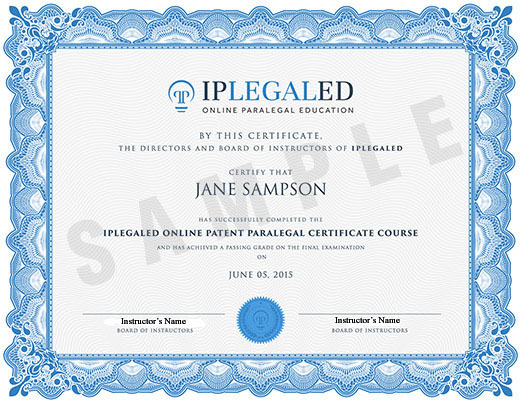
Final Certificate
Once you have passed the Final Exam with a grade of 70% or higher, we will send you a certificate suitable for framing. Please allow up to 6 weeks as our print shop does these in batches.
FAQ
Is this course ABA approved?
It should be noted that the ABA (American Bar Association) only approves courses that include General Education, which is defined by the ABA as, “an academic college-level course designed to give students a broadly based liberal arts education,” so the IPlegalED course cannot be approved by the ABA under the current rules, which are not designed for approval of such specialized professional courses.
Additional information
The IPlegalED course has been designed and written by expert practitioners to be the very best course possible – the gold standard of patent paralegal education. Upon completing the course and passing the final exam, you will be awarded a certificate showing that you successfully completed the IPlegalED Patent Paralegal Certificate Course and passed the final exam.
The IPlegalED course is not designed to provide general, non-specific paralegal training, and does not provide a general paralegal certificate. Many courses exist to provide such general paralegal training and are often offered at community colleges, but these general courses do not teach patent paralegal skills and are of little value to a law firm or corporation looking for a professional patent paralegal. The IPlegalED.com course is a specialized, professional course designed to teach patent administration only. It should be noted that ABA only approves courses that include General Education, which is defined by the ABA as, “an academic college-level course designed to give students a broadly based liberal arts education,” so the IPlegalED course cannot be approved by the ABA under the current rules, which are not designed for approval of such specialized professional courses. Whether or not you are technically entitled to call yourself a paralegal in any given state varies from state to state. In many states the term has no fixed meaning and is simply a commonly used work descriptor meaning someone who supports an attorney. Some companies use the word, “Specialist” as a title for the same job. In some states, the word paralegal has been codified in the state’s legal code (e.g. in California see the business and professions code section 6450-6456 which requires a certain number of years of experience and/or academic qualifications).
We ship certificates destined to U.S. addresses by U.S. Postal Service First-Class Mail. If we mail your certificate and it is returned as undeliverable, or if you would like us to reissue your certificate, the fee to mail it again will be $35.
For foreign addresses we ship via U.S. Postal Service First-Class Mail. If lost or undeliverable, as a courtesy, we will ship tracked Priority Mail International one time for free. Any additional services (such as FedEx), mailings, or certificates will be at the student’s expense. Please note: We are not the Post Office and we do not control the mail. The U.S. Postal Service offers tracking to foreign countries when using Priority Mail International, however, once it leaves the US, the local postal service of the destination country takes over.
If a certificate is returned as undeliverable or sent to a student twice, a copy of letterhead with address from a business or other proof of address (a copy of the mailing address from a utility bill) must be supplied and the certificate will be sent to that address. If you have any questions, please contact us at questions (at) iplegaled.com.
Who uses the IPlegalED course?
The IPlegalEd Patent Paralegal Certificate Course is used by top international corporations, law firms and government departments.
Some of our clients include:
A
Acushnet Company
Adelphia
Advanced Technology Materials, Inc.
Agere Systems
Agilent Technologies, Inc.
Agouron Pharmaceuticals, Inc.
Alcon Labs
American Medical Systems, Inc.
Aprisma
ARIAD Pharmaceuticals, Inc.
Ater Wynne LLP
Atofina Chemicals, Inc.
Avigen
B
BAE Systems
Bard Peripheral Vascular, Inc.
Battelle Energy Alliance, LLC
Bausch & Lomb
BellSouth
Bemis Company, Inc.
Bendix
Bereskin and Parr
Berkeley Law & Technology Group, LLP
Berlex
Birch, Stewart, Kolasch & Birch
Blakely, Sokoloff, Taylor & Zafman
Boehringer-Ingelheim
Boeing
Bricker & Eckler
Buchanan Ingersoll LLP
Burle Industries
Butler, Snow, O’Mara, Stevens
C
Carella, Byrne, Bain, Gilfillan, Checchi
Cargill
Carrier
Cephalon
Celera Genomics
Ceptyr, Inc.
Charm Sciences, Inc.
Chevron
Cingular Wireless
Clark and Bellamy PC
Cleveland Golf
CNH America LLC
Cognis
Computer Associates International, Inc.
Conexant
Cornell Research Foundation, Inc.
Cougar Patent Law
Coviden Inc.
Cox & Smith, Inc.
CPA Global
CP Kelco US, Inc.
Crane, Caton & James P.C.
Cree Inc.
Cummins Inc.
Cyberonics, Inc.
D
Davis Wright Tremaine, LLP
DepoMed
Dorsey & Whitney, LLP
Dow Corning
Downs Rachlin Martin PLLC
Duane Morris
DuPont
E
E. I. Du Pont de Nemours and Company
Edwards Lifesciences Corp.
Elan Pharmaceuticals, Inc.
Elmore Craig
Eltech Systems Corp.
Endo Pharmaceuticals, Inc
Enterasys Networks
Epix Medical, Inc.
Exelixis
F
Friedman, Suder & Cooke
G
GE
GE Aviation
General Patent Corporation
Gibson Dunn & Crutcher
Greenberg Traurig LLP
Greensfelder
H
Hamre, Schumann, Meuller & Larson
Harvard Medical School
Haynes Beffel & Wolfeld LLP
Headway Technologies
Hensley Kim & Edgington
Hewlett-Packard Company
Holland & Hart LLP
Hollis-Eden Pharmaceuticals
Honeywell
Howison & Arnott, L.L.P.
Husch & Eppenberger, LLC
Hydro-Gear
I
IBM
Immersion Corp.
Insight Technology
InterDigital Communications, LLC
Inventive Solutions, Inc.
Invista
Invitrogen
J
Jack Schwartz & Associates
Jagtiani + Guttag
Jenkins & Gilchrist
Johns Hopkins
Johnson & Johnson
K
Kacinsky LLC
Kalow & Springut LLP
KCI
Kellogg Brown & Root, Inc.
King Research & Law
Kodak Polychrome Graphics LLC
Kramer & Associates, P.C.
L
Lahive & Cockfield, LLP
Lai & Associates P.C.
Lawfirm of Jim Zegeer
Law Offices of Jay R. Hamilton
Lawrence Berkeley National Lab
Lanxess
Leapfrog Enterprises, Inc.
LeCroy
Lee & Hayes, PLLC
Lexmark International, Inc.
LifeNet
Lilly
Los Alamos National Laboratory
Lowenstein Sandler, PC
Luna Innovations Incorporated
Lyondell Basell Industries
M
MacCord Mason PLLC
McKean Defense Group
McKee, Vorhees & Sease
MedicineLodge, Inc.
Medtronic
Medtronic Spinal & Biologics
Merial Limited
Milliken & Co.
Millipore
Myriad Genetics, Inc.
N
NASA
National Starch and Chemical
National Oilwell Varco
Needle Rosenberg
Neurogen Corp.
Neuromed Pharmaceuticals
Neuromedtech
New England Biolabs
Nokia
Norris, McLaughlin & Marcus
Novartis
Noven Pharmaceuricals, Inc.
Nutter, McClennen & Fish
O
Ocean Power Technologies, Inc.
Offices of Leona L. Lauder
Offices of Russ Weinzimmer
Oktay Enterfprises
P
Palatin Technologies, Inc.
Palomar Medical Technologies, Inc.
Pentron
Pepper Hamilton LLP
Pfizer, Inc.
Pharmacia & Upjohn Company
Pierce Atwood
Pixel Optics, Inc.
Polster, Lieder, Woodruff & Lucch
PPG Industries, Inc.
Preston Gates & Ellis LLP
Proctor & Gamble
Purdue Pharma
Purdue Research Foundation
Q
R
Raj Patent
Raju & Sarracino, LLC
Rambus, Inc.
Reed Smith LLP
Reinhart Law
Research In Motion (RIM), Inc
Rockwell Scientific
Ropes & Gray LLP
RSA, The Security Division of EMC
S
Sabic Americas, Inc.
San Diego County Credit Union
Schlumberger Technology Corp.
Schwabe, Williamson & Wyatt P.C.
Scientific-Atlanta, Inc.
Scios
Seagate Technology, LLC
Sealed Air, Inc.
Serono/SRBI
Sheridan Ross P.C.
Shire Laboratories
Shugart Thompson & Kilroy, P.C.
Sierra Law
Sierra Patent Group, Ltd
Silverman Santucci, LLP
Specialized Health Products
Stinson Moheck
Stradley Ronon Stevens & Young
Stradling Yocca Carlson & Rauth
Sughrue
Suiter West PC LLO
Sunbeam
SurModics, Inc.
T
Tanox
Technology Patents and Licensing
Tellink, Inc.
Theravance
Thompson Associates
Thompson Licensing Inc.
Thompson & Simmons PLLC
TransTech Pharma
Trask Britt, P.C.
Tucker Arensberg, PC
TVGateway, LLC
Tyco Fire & Security
Tyco Healthcare
U
University of Louisville
University of Nevada, Reno
University of Rochester
University of Rochester Medical Center
USA Space & Missile Defense Command
USDA Agriculteral Research Service
USDA Forest Service
U.S. Dept. of Energy
U.S. Army
V
Vedder Price
Verizon
Vertex Pharmaceuticals, Inc.
Virginia Tech Intellectual Properties
W
Wagner, Murabito & Hao LLP
Watson Pharmaceuticals, Inc.
Wayne-Dalton
West Corp.
Wisconsin Alumni Research Foundation
Workman Nydegger
W.L. Gore & Assoc., Inc.
X
Y
Z
Zimmer
INTERNATIONAL CLIENTS
-=Australia=-
Silverbrook Research
-=Canada=-
Alberta Research Council
BCF LLP
Fasken Martineau
Gowlings
Husky Injection Molding Systems
Shire, Inc.
-=China=-
Schlumberger
-=Denmark=-
Inspicos A/S
-=Israel=-
NDS Technologies Israel Limited
-=Japan=-
Schlumberger KK
Seikagaku
-=Russia=-
Schlumberger
-=Saudi Arabia=-
Saudi Arabian Oil Company
Is the course accredited by any national organization? Can I get CLE credit?
Yes! The IPlegalED Patent course is approved for 12 CLE credit hours, and the IPlegalED Trademark course is approved for 10 CLE credit hours by The National Federation of Paralegal Associations (NFPA) (www.paralegals.org/), which is the largest paralegal organization in the USA. The IPlegalED course is also endorsed by the IP Society of Silicon Valley (www.ipsociety.net/).
Payment and access
How much does the course cost?
The cost of the entire course is $2,495. There are absolutely no hidden or additional costs.
Refunds
The IPlegalED course is a digital product and as such, once purchased, the course fee will
-
not
be refunded. The course may be credited to be used at another time if documented and verified exigent circumstances such as health or unexpected loss of employment are shown and certified by a third party.
Can I pay in installments?
Yes. We are set up to process monthly recurring credit card payments for individual registrants in the US only. If a business, corporation, or law firm is paying, the installment plan may not be used. If you would like to use the installment plan, please contact us at questions@iplegaled.com. We will send you the forms you need to apply. The forms are not available on the web site. This plan is for US cards only.
Extensions and Suspensions
In the rare case that a student requires extra time to complete their course, an extension of time may be purchased. This will add a set amount of time to the current clock. Time may be purchased in one, two, or three month increments, and must be paid for by credit card at the time of request. Only one extension may be purchased per course.
Any suspensions to a course clock are only for one month, and are not extendable. While a course is suspended, the student has no access to the online course or quizzes.
Any extensions of time or suspensions must be requested and approved in writing BEFORE the expiration of their 100 day timer.
Can I save the course to more than one computer?
Yes. Many students save the course to their work computer and also to their home computer to allow them the flexibility of studying at both locations. You are allowed to download the course to two (but no more than two) computers. The course may only be used by the registered student of record. All materials are copyrighted and the copyright is strictly enforced.