















IPlegalED’s Trademark Paralegal Certificate Course
- All trademark procedures, rules, and forms carefully explained
- Clearly written, comprehensive, and up-to-date
- Unlimited online support from practicing professionals
- Continuously updated with all the latest rules
- Simple step-by-step instruction and practice forms
- Designed to help you understand the procedures, not just follow them
- Study at your own pace, online or off-line, at work or at home
- Filing and administration of U.S. and international
trademarks
Lessons
CHAPTER 1: INTRODUCTION
Ch.1/A: The United States Trademark System
- Overview of the Trademark Registration Process
Ch.1/B: Trademarks – General Concepts
- Why We Have a Trademark System
- The Lanham Act
- What is a Trademark?
- What is a Domain Name?
- What is a State Trademark?
- What is a Service Mark?
- What is a Collective Mark?
- What is a Collective Membership Mark?
- What is a Certification Mark?
- What is a Concurrent Use Registration?
- What is a Trade Name?
- What is Trade Dress?
- What are House Marks and Product Marks?
- What is Right of Publicity?
- What are Trade Secrets?
- How Long Does a Trademark Last?
- State Versus Federal Registration
- Is Registration of a Trademark Necessary?
- What Kind of Protection Does a Trademark Offer?
- What is the Value of a Registered Trademark?
- What Does the USPTO Do?
- How an Application Becomes a Trademark (Trademark Prosecution)
- Trademark, Service Mark and Registered Symbols
- The Trademark Registers – Principal and Supplemental
- The Principal Register
- The Supplemental Register
- Resources: Laws and Rules and the TMEP
- The USPTO Web Site
- The Filing Date
- Docketing
- Structure of a Trademark File
CHAPTER 2: MARK SEARCHES, FILING BASIS, DRAWINGS, AND SPECIMENS
Ch.2/A: How a Trademark is Chosen
Ch.2/B: What Makes a Good & Strong Trademark
Ch.2/C: Conducting Trademark Clearance Searches
Ch.2/D: Goods & Services – Classifications
Ch.2/E: Basis for Filing a Trademark Application
- Use in Commerce
- Intent to Use (ITU) Application Under Section 1(b) of the Trademark Act
- Priority Based on Foreign Filing of an Application Under Section 44(d)
- Priority Based on Foreign Registration Under Section 44(e)
Ch.2/F: Drawings
- Standard Character (or Typed) Drawing
- Stylized or Special Form Drawing
Ch.2/G: Specimens of the Trademark
- Specimens – Goods
- Specimens – Services
- Specimens – Collective Membership
- Specimens – Certification Mark
- Specimen Refusal During Examination
- Responding to a Refusal of a Specimen
CHAPTER 3: CORRESPONDING WITH THE USPTO
Ch.3/A: How to Communicate With the Patent & Trademark Office
Ch.3/B: Electronic Filing Using TEAS – Brief Overview
Ch.3/C: Filing by Mail
Ch.3/D: Faxing Documents to the USPTO
Ch.3/E: Email Correspondence With the USPTO
Ch.3/F: Hand Delivered Documents
Ch.3/G: Methods of Payment
Ch.3/H: The USPTO Financial Manager System
CHAPTER 4: FILING A USE-BASED TRADEMARK APPLICATION
Ch.4/A: Filing a Use-Based Trademark by Mail
- The Transmittal Sheet
- Parts of the Use-Based Trademark Application
- Specimens
- A Return Receipt Post Card (Only if Filing by Mail)
- Application Format
- Drawings Format (for Stylized Marks Only)
- Specimen Format
- Finalizing the “Use” Application for Filing by Mail
Ch.4/B: Using TEAS to File a Trademark Application on the Principal Register
- TEAS, TEAS Plus and TEAS Reduced Fee (TEAS RF)
- Elements in TEAS Applications
- Additional Requirements for a TEAS Plus Application
- Ongoing Requirements for TEAS Plus Application, After Filing
- Signatures
- Statement of Consent to Registration
- TEAS Tutorial
- TEAS Plus Option
- TEAS Image Submission
- TSDR (Trademark Status and Document Retrieval)
Ch.4/C: Power of Attorney
Ch.4/D: Assignments and Assignment Recordation
CHAPTER 5: FILING AN INTENT-TO-USE (ITU) TRADEMARK APPLICATION
Ch.5/A: The Intent to Use (ITU) Application
Ch.5/B: Filing an ITU Application by Mail
Ch.5/C: Filing an ITU Application Using TEAS
Ch.5/D: Allegation of Use (Statement of Use / Amendment to Allege Use)
- Filing an Amendment to Allege Use / Statement of Use by Mail
- Using TEAS to File a Statement of Use / Amendment to Allege Use
Ch.5/E: Request for Extension of Time to File a Statement of Use
- Filing a Request for Extension of Time to File a SOU by Mail
- Using TEAS to File a Request for Extension of Time to File a SOU
Ch.5/F: Docketing After Filing a New Application
CHAPTER 6: ASSIGNMENTS & ASSIGNMENT RECORDATION
Ch.6/A: Recordation Form Cover Sheet (Form PTO-1594)
Ch.6/B: Electronic Filing Using ETAS
Ch.6/C: Change of Name Using ETAS
CHAPTER 7: TRADEMARK PROSECUTION
Ch.7/A: The Pre-Examination Stage (TMEP 401)
- Filing Receipt and Corrected Filing Receipt
- Notice of Incomplete Trademark Application
- Pseudomarks
Ch.7/B: Trademark Examination (TMEP 700 and 1200)
- First Action Allowance
- Refusal and Office Action
- Office Actions
- Reviewing the Office Action and Docketing Due Dates
- Responding to the Non-Final Office Action Using TEAS
- Responding to the Non-Final Office Action by Mail
- Priority Action (TMEP 708)
- Extensions of Time (None)
Ch.7/C: Final Office Action (TMEP 714)
- Response to a Final Office Action
- Request for Reconsideration After a Final Office Action
- Filing a Notice of Appeal and Appeal Brief
- Amending the Application to Comply With Requirements Made by the Examiner
- Filing a Petition to the Commissioner
- Amending the Application to Have it Placed on the Supplemental Register
- Submitting Evidence of Secondary Meaning
- Abandoning the Present Application and Giving Up Altogether
- Abandonment (37 CFR 2.65)
- Revival of an Abandoned Application (37 CFR 2.66)
- Suspension
- Division of an Application
Ch.7/D: Letters of Protest (TMEP 1715)
CHAPTER 8: APPEAL
Ch.8/A: Notice of Appeal
Ch.8/B: Appeal Brief
Ch.8/C: Appeal Brief – Form and Content
Ch.8/D: Oral Hearing
Ch.8/E: Examiner’s Brief
Ch.8/F: Appellant’s Reply Brief
Ch.8/G: Amendment During Appeal
Ch.8/H: An Example of an Appeal
Ch.8/I: Filing an Appeal Online Using ESTTA
CHAPTER 9: AFTER PROSECUTION
Ch. 9/A: Publication for Opposition
Ch. 9/B: Notice of Allowance (NOA)
Ch. 9/C: Statement of Use (SOU)
CHAPTER 10: AFTER REGISTRATION
Ch.10/A: Declaration of Continued Use in Commerce (a §8 Declaration)
Ch.10/B: Affidavit of Incontestability (§15 Affidavit)
Ch.10/C: Term and Renewal
CHAPTER 11: THE MADRID PROTOCOL
Ch.11/A: What is a Madrid Protocol Application?
Ch.11/B: When is Filing a Madrid Protocol Application Applicable?
Ch.11/C: Madrid Protocol Application Filing Requirements
Ch.11/D: How is a Madrid Protocol Application Filed and Processed?
- Filing a Madrid Protocol Application Using TEAS
- Filing a Madrid Protocol Application by Mail
- Hand Delivery
- Fees
Ch.11/E: Advantages of the Madrid Protocol
Ch.11/F: Maintaining and Renewing a Madrid Protocol Trademark
CHAPTER 12: THE EUROPEAN TRADE MARK SYSTEM (FORMERLY CTM)
CHAPTER 13: ONGOING PROTECTION OF TRADEMARK RIGHTS
Ch.13/A: Non-Use
Ch.13/B: Generic Use
Ch.13/C: Enforcement
Ch.13/D: Counterfeiting
Ch.13/E: US Customs Protection (Department of Homeland Security)
Ch.13/F: Ex Parte Expungement and Reexamination
CHAPTER 14: LICENSING
CHAPTER 15: TRADEMARK COURSE – FINAL EXAM
-
1
1. Preface and Introduction
-
2
2. Mark Searches, Filing Basis, Drawings, and Specimens
-
3
3. Corresponding with the USPTO
-
4
4. Filing a Use-Based Trademark Application
-
5
5. Filing an Intent-to-Use (ITU) Trademark Application
-
6
6. Assignments & Assignment Recordation
-
7
7. Trademark Prosecution
-
8
8. Appeal
-
9
9. After Prosecution
-
10
10. After Registration
-
11
11. The Madrid Protocol
-
12
12. The European Trade Mark System (formerly CTM)
-
13
13. Ongoing Protection of Trademark Rights
-
14
14. Licensing
-
15
15. Trademark Course Final Exam
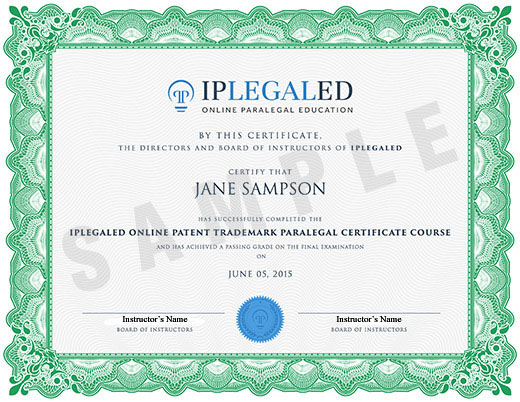
Final Certificate
Once you have passed the Final Exam with a grade of 70% or higher, we will send you a certificate suitable for framing. Please allow up to 6 weeks as our print shop does these in batches.
FAQ
Is this course ABA approved?
It should be noted that the ABA (American Bar Association) only approves courses that include General Education, which is defined by the ABA as, “an academic college-level course designed to give students a broadly based liberal arts education,” so the IPlegalED course cannot be approved by the ABA under the current rules, which are not designed for approval of such specialized professional courses.
For all levels of trademark paralegal
Trademark administration is a very demanding area of legal administration. There are rules to master, abstract concepts to understand and always deadlines to meet. Qualified trademark paralegals (also called trademark specialists or trademark secretaries) are in high demand and are well paid. A trademark paralegal works with one or more trademark attorneys and handles all the administrative work involved in the long and complex process for trademark clearance (searching), application, surveillance and enforcement. This usually involves a lot of formal correspondence between the trademark attorney and the United States Patent and Trademark Office (USPTO). It’s a profession that requires intelligence, initiative and good organizational skills. Regular paralegals cannot do this work and a considerable degree of training is required. Experienced trademark paralegals are often given a great deal of responsibility for day-to-day trademark matters.
If you are an experienced trademark paralegal
The course will provide you with a valuable and comprehensive refresher of your skills, will help you remember what you may have forgotten, and will bring you up to date with all the new rules.
If you have just a couple of years experience
The course will provide a clear, step-by-step guide to trademark administration, and teach you all that you need to know to confidently handle the administration of a trademark portfolio, in a law firm or in a corporate trademark department. The course book will be a valuable reference source.
If you are new to trademark administration
The course been carefully designed from the ground up to explain all terms and principles that you will need to understand the more complex elements of trademark administration. It requires no specific prior knowledge, just a willingness to learn. Of course, the less experience you have, the more time you may want to spend on the early chapters, but that should not be a problem. The IPlegalED course has been designed so that you can work at your own pace and stop, start, or repeat sections as often as you wish.
About the IPlegalED course
The IPlegalED trademark paralegal course is the first complete, self-contained course designed to teach you how to confidently handle the administrative side of trademark practice. It is written in plain English, with the minimum of unnecessary legal jargon to make it clear and easy to follow. Whether you’re taking it to refresh your skills, catch up on new or infrequently used rules, or are embarking upon an entirely new career, you’ll find all you need to know right here.
The course will provide you with complete, clear, step-by-step directions to guide you through the often bewildering maze of trademark administration procedures, showing you how to fill out forms, docket dates and file documents with the Trademark Office. In short, we teach you how to confidently handle everything necessary to support one or more trademark attorneys, either at a law firm, corporation, government department, or university.
The course is designed to be useful for all levels of experience, from novice to highly trained trademark paralegals with many years of experience. If you are highly experienced you will no doubt cover the early chapters quickly. A novice will have to spend more time learning the fundamental principles of trademark law which are covered in detail early in the course using a simple, plain-English style of prose. No matter what your level of experience, you will find this course useful, informative and helpful in your day-to-day trademark paralegal practice.
Payment and access
Is there a deadline for registration?
No. Registration is ongoing, and you can register at any time you like, 365 days per year. Simply use the online registration process found on the IPlegalED.com homepage.
How much does the course cost?
The cost of the entire course is $1,695. There are absolutely no hidden or additional costs.
Refunds
The IPlegalED course is a digital product and as such, once purchased, the course fee will
-
not
be refunded. The course may be credited to be used at another time if documented and verified exigent circumstances such as health or unexpected loss of employment are shown and certified by a third party.
Can I pay in installments?
Yes. We are set up to process monthly recurring credit card payments for individual registrants in the US only. If a business, corporation, or law firm is paying, the installment plan may not be used. If you would like to use the installment plan, please contact us at questions@iplegaled.com. We will send you the forms you need to apply. The forms are not available on the web site. This plan is for US credit cards only.
Are printed reference materials provided?
Yes. The entire text of the course is designed to be downloaded and printed out to provide a useful day-to-day working reference with step-by-step instructions covering all aspects of trademark administration.
Are there videos?
No. We find that it limits the student’s ability to take the course offline, and once the student’s course expired, they would no longer be able access to the videos. Once the textbook is downloaded, however, it may be referenced days, months, and years after the course has expired.
What happens if I have questions?
Unlimited, expert support from trademark professionals is available online. Additionally, the course has been carefully designed to anticipate and answer the most common questions that you may have.
Does my computer have to be online to take the course?
No. The course is designed to be downloaded to your computer and / or printed out, so you do not have to be logged on to study. In fact, if you choose to print out the course, you do not even have to use a computer to study. Only the quizzes and the final exam must be taken and graded online.
Can I repeat sections if I need to?
You can stop, start, or repeat sections and quizzes as often as you need. For the quizzes, only your most recent score is recorded. The final exam may be retaken up to three times (see below).
Will there be tests?
Yes. The IPlegalED course is an interactive course, designed to teach, reinforce and test your knowledge. A multiple choice quiz is given at the end of each chapter. When you’ve completed all the chapters, there is a final exam. A score of 70% or above is required to pass the course, and a certificate is awarded upon passing. If you do not pass the final exam within three (3) attempts, you will be allowed to retake the final exam an additional three times for a fee.
How long will the course take?
The entire course should take between about 50 and 100 hours, possibly longer if you are a novice. You have 100 days from the exact second the course is activated to complete the course, so you should have plenty of time. We recommend the student take the final exam the day *before* the timer ends to ensure they can complete the final before the clock expires.
How long do I have to complete the course?
You will have 100 days from the exact second the course is activated to complete the course, including taking and passing the final exam. You will receive an email as soon as the course is activated. This should be plenty of time. If, however, you are unable to complete the course in that time, you may contact us to obtain an extension for a fee.
How long after passing the Final Exam will I receive my certificate?
We ask that you allow 6 weeks from taking your Final Exam.
Extensions and Suspensions
In the rare case that a student requires extra time to complete their course, an extension of time may be purchased. This will add a set amount of time to the current clock. Time may be purchased in one, two, or three month increments, and must be paid for by credit card at the time of request. Only one extension may be purchased per course.
Any suspensions to a course clock are only for one month, and are not extendable. While a course is suspended, the student has no access to the online course or quizzes.
Any extensions of time or suspensions must be requested and approved in writing BEFORE the expiration of their 100 day timer.
Can I save the course to more than one computer?
Yes. Many students save the course to their work computer and also to their home computer to allow them the flexibility of studying at both locations. You are allowed to download the course to two (but no more than two) computers. The course may only be used by the registered student of record. All materials are copyrighted and the copyright is strictly enforced.
What does the IPlegalED certificate mean to an employer?
The IPlegalED course is a nationally recognized, professional course designed to teach trademark administration. The IPlegalED course is not just about getting a certificate, it is about becoming an excellent, highly competent and sought after trademark paralegal; someone who really understands the complexities of trademark work. That is who employers are looking for. The IPlegalED certificate provides a valuable and recognized formal qualification awarded for having successfully taken the course and passed the final exam. It is not simply a certificate of completion. IPlegalED is nationally recognized, used by many corporations, law firms and government departments. The course is approved for paralegal continuing education credit by the National Federation of Paralegal Associations (the largest paralegal organization in the US). The IPlegalED course has been designed and written by expert practitioners to be the very best course possible – the gold standard of trademark paralegal education. Upon completing the course and passing the final exam, you will be awarded a certificate showing that you successfully completed the IPlegalED Trademark Paralegal Certificate Course and passed the final exam.